
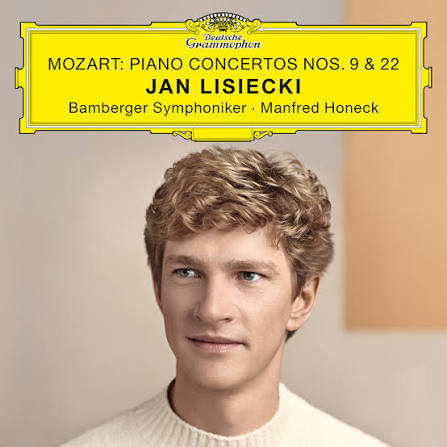
I had the opportunity to chat all things Mozart with Canadian pianist Jan Lisiecki. He’s releasing his second Mozart album on Friday, April 17th. It’s been over a decade since his debut album with Deutsche Gramophone. He’s since then been very busy recording, touring, and performing some of the greatest works in the repertoire.
MM: Well, Jan, thank you so much for your time. This is internationally-acclaimed pianist -you’re performing over a hundred concerts a year right now traveling the world. So, where are you right now?
JL: I’m actually home in Calgary. A rare moment of being at home before … hopefully leaving tomorrow morning as we have a major snowstorm. Probably the last of the season coming through overnight and I’m going to St. Louis tomorrow.
MM: Well, thank you so much for your time. I understand that we are preparing quite a bit of … Mozart is the majority of this leg. You’ve got your album coming out this Friday. I know that your debut album was also Mozart. How’s that compare this this time around? That was 2012 when that was released, correct?
JL: That’s right. We’re so many years past that already. 14 years ago and amazing history with that album.
Mozart was actually one of the reasons I ended up recording with Deutsche Grammophone at the beginning because I already had a different offer from a different label on the table and we were talking about repertoire. They had a very specific thing in mind. I had a very specific thing in mind, which was Mozart. We couldn’t come to terms on doing that and so we parted ways and a little while later – quite literally a very short while later – Deutsche Grammophon came into the picture. We had the same discussion and they said “Sure, no problem! Mozart’s absolutely great.” So that’s what finds me here today and, as a result, I feel very very happy to come full circle return to Mozart’s music.
The intention of recording Mozart back when I was so young was to actually showcase my approach to music. Not showcase my abilities as a pianist, but actually just how I interpret music, how I play music.
Mozart is unique because it doesn’t offer you a place to to hide a lot of emotions to to sort of delve into. It’s pure. It’s joyous, of course. It’s it’s beautiful, of course, but we have to find our own way through it. I love Mozart and I’m very happy to come back to it for this recording.
MM : I adore Mozart as well. We’re excited to hear it. I’m curious if there’s anything different in your approach to Mozart at this stage in your life compared to the first round.
JL: Well, I hope in a sense there isn’t. Of course, there’s experience and, so to speak the wisdom that come with experience, but there’s a very famous quote in in music industry that “Mozart should be played when you’re very young and innocent or very old and wise.” And I don’t really fit into either of those right now. But I still hope that my Mozart playing has relevance and and is still can keep up with the young and energetic and old and wise.
Because Mozart does have certainly the issue that, if you start overthinking it and if you start delving too deeply into it you start trying to solve the issues to understand everything. Then you lose that that spark – that beauty of the music – and that I think is the two things that both the “young and the innocent” and the “old and wise” have in common.. finding that beauty, finding the the essence of the music. Where the innocent don’t know better and the wise know exactly what to throw out. And I think that’s the key in Mozart is to find that spark, to find that center. Playing it is always a a joy for me.
MM: That makes that makes perfect sense. I think that there’s there’s so many points of connection in Mozart’s music that you can have with with Mozart and with the audience. Are there any performers or conductors or folks that in your experience of Mozart, you felt that connection first as an audience member? Or in recordings?
JL: Yes. I remember hearing recordings when I was young of Maria João Pires playing Mozart and just feeling that’s so magical and there’s countless others as well from my side as a performer. But coming back to the subject at hand, which is that’s exactly what I felt when I first worked with Manfred, and when I saw how he was working with the orchestra on Mozart his approach to the details his approach his care for for this music of course steeped in a in a very strong Viennese tradition. But also alive and that was very special. I knew immediately that I wanted to work more with him and play more Mozart with him and that ultimately led to the recording which I’m very grateful for.
MM: It’s interesting too, with as much travel and performances you do, there would be different spaces and different audiences that are receiving Mozart probably differently. Even if it’s, you know, every evening is probably a different leg. “Club, ‘nother club” type of thing. Are there any halls that are particularly special for Mozart or just in general when you’re meeting these new audiences what are you excited for?
JL: Well, I think it in any case, it’s a privilege to bring Mozart to the stage no matter what the stage. Certainly, it’s much easier with orchestras that are more accustomed to playing Mozart. And predominantly you’ll find that to be certain European orchestras and chamber orchestras and orchestras that that work in that repertoire. It’s a bigger challenge when you come to the large symphony orchestras, regardless of whether that’s in Europe or in North America. But of course, in North America we have predominantly large symphonic orchestras which are accustomed to playing the the greats of the repertoire.
The symphonic greats we have a lot of Mahler, Beethoven, Prokofiev… A lot of great symphonies that require a large orchestra high skills incredible playing – but pairing that back down to Mozart that is a big challenge. I think audiences universally appreciate Mozart, but don’t necessarily get to experience it as much as they should in certain places. And for that reason I always push for Mozart – I’m very happy of course beyond playing the great myself as well. I’m certainly not a Mozart specialist by any means and nor do I intend to be. But incorporating that into the broader repertoire gives uh reprieve, gives a moment of of respite from from the the sort of great symphonic sound, is a more detail-oriented approach. It’s certainly very demanding from all of us and is very, very rewarding ultimately. And that reward is worth the wait. Worth the challenge.
MM: It sounds like a phenomenal challenge to have. I guess I’m also curious how playing Mozart with that attention to detail and with that conversation, kind of retrospectively… how does that inform your playing of more Romantic or or more contemporary music?
JL: Hugely. Because when you spend too much time in in that large music, the music that that makes a sound for itself, you can very easily… not ignore, but start to hide certain details because you can focus on those those amazing aspects, the big aspects. When you come back to Mozart and you realize, “Oh, I have to really focus on everything because anything out of place makes a huge difference.” Then you realize that that same approach can be had also in these large pieces. That attention to detail if it’s transposed later to music by Chopin, music by Rachmaninoff, music by Prokofiev, it does have an incredible effect. Because you are really thinking, not only symphonically in the in the sense of great sounds but also in more analytical and more attention-focused, detail-focused performance and I think it has a lot of value.
MM: I saw a little bit of an interview where you’ve described in the past being really intentional…not only in your playing, obviously, but in how you approach taking the stage and how you approach recording. I’m curious when you talk about that either religious or artistic intention immediately before a performance… Is there anything different for Mozart for you that you, either in a performance space, immediately before you have an intention for Mozart that’s different for other performances?
JL: Yes, I think you have to have an even more immediate intention because with a lot of works, say great concertos by Chopin or Beethoven, there’s a little bit of room to get into the music. You have that time, the space.
With Mozart, if you aren’t immediately there, it’s almost like … if you compare a sport that is endurance or a sport that is high performance. And I think here in Mozart it’s just high performance, short burst… not that short ultimately. It’s not any shorter than anything else, but but you need that focus from the very beginning. If you miss the start then everything else also doesn’t fall into place as it should. So, yes with Mozart certainly, it has to have the right intention from the very beginning. You can’t ease into it. Uh there is an immediiacy.
MM: Well thank you so much. Keeping that sports-mind with endurance in the middle or beginning of your next leg… I don’t know if you’re a Flames fan or any of those things but I wish you all of the endurance and strength for for the next bits. I know St. Louis will be so happy to see you and we will be so thrilled to listen to your recording dropping this Friday. Best wishes for the next bits of the tour.
JL: Thank you. Great pleasure speaking to you.

 Mickey Miller